
Dyslexia vs. Reading Delays: How Calgary Parents Can Tell the Difference

Why This Question Matters So Much
Many Calgary parents come to us feeling confused, worried, or overwhelmed. They notice their child is struggling with reading but aren’t sure why. Is this simply a reading delay? Is it dyslexia? Is it something they will outgrow—or something that needs targeted support?
You’re not alone.This confusion is extremely common, especially because dyslexia isn’t always recognized early in classrooms, and reading delays can sometimes look very similar in the early stages.
The truth is this:
👉 A reading delay and dyslexia are NOT the same thing👉 The difference affects what type of support your child needs👉 Early intervention—especially structured literacy—is the key to success
This guide will help you understand the differences, the signs to look for, and the best next steps for Calgary families seeking reading support.
What Is a Reading Delay?
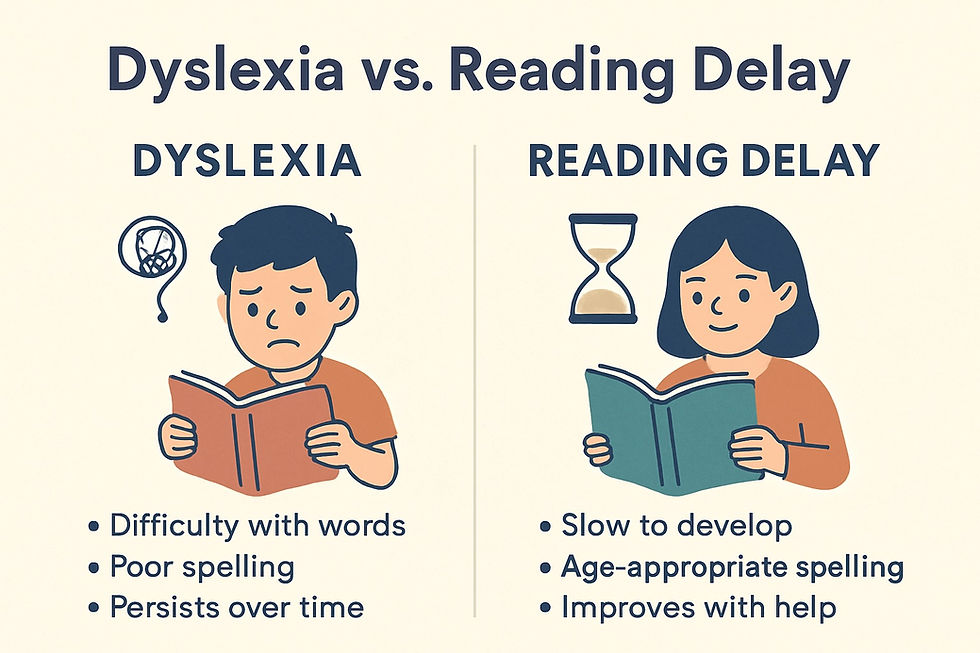
A reading delay means a child is not reading at the level expected for their age—but the underlying learning systems are intact. In other words:
the child simply needs more time
they may have missed foundational skills
they may need more exposure to reading
the delay may be environmental (e.g., limited reading opportunities)
Reading delays can be caused by:
starting school young
inconsistent instruction
missed school time
second-language challenges
limited phonics exposure
Children with reading delays generally catch up with consistent practice and solid instruction.
What Is Dyslexia?
Dyslexia is a neurological learning difference that affects how the brain processes language—especially phonological processing.
Children with dyslexia struggle with:
connecting letters to sounds
sounding out new words
spelling
reading fluency
working memory
sequencing
Dyslexia is NOT caused by:
low intelligence
poor parenting
lack of motivation
In fact, dyslexic learners are often bright, creative, intuitive thinkers who excel in visual, hands-on, or problem-solving tasks.
The key difference:
👉 Dyslexia does NOT resolve on its own.👉 It requires structured, explicit reading instruction.
This is why more families are seeking dyslexia tutoring in Calgary—because waiting often widens the reading gap.
Signs Your Child May Have a Reading Delay (Not Dyslexia)
Children with reading delays often show milder, more global challenges. Common signs include:
1. Late exposure to reading
Not enough books, reading time, or phonics instruction early on.
2. Inconsistent schooling
Moves, absences, or disruptions can cause gaps.
3. Mild difficulty with certain concepts
They struggle, but learn steadily with repetition.
4. Slow but noticeable progress
With consistent reading practice, they improve.
5. No major issues with phonological awareness
They can rhyme, clap syllables, and identify beginning sounds.
What usually helps?
extra practice
phonics instruction
reading aloud
guided reading support
These learners can catch up quickly with the right help.
Signs Your Child May Have Dyslexia
Dyslexia symptoms are more pronounced, persistent, and specific.
1. Difficulty connecting letters and sounds
Your child can’t reliably remember which sound goes with which letter.
2. Struggles to sound out even simple words
Words like “cat,” “map,” “shop,” or “left” may be hard.
3. Guessing instead of decoding
They rely on pictures or context clues.
4. Spelling that seems “all over the place”
Spelling is inconsistent, missing letters, or reversed.
5. Difficulty remembering sequences
Days of the week, number patterns, steps in tasks.
6. Slow, effortful reading
Even familiar texts feel tiring.
7. Family history of reading challenges
Dyslexia is highly hereditary.
8. Reading does NOT improve with extra practice
This is the biggest indicator.
A child with dyslexia will not progress significantly with:
memorizing sight words
guessing strategies
reading leveled books
repeated reading without decoding instruction
What they need is structured literacy tutoring, which rewires the brain’s reading pathways.
Feature | Reading Delay | Dyslexia |
Cause | Limited exposure or instruction | Neurological difference |
Severity | Mild to moderate | Moderate to severe |
Response to Practice | Improves with repetition | Minimal improvement |
Letter-sound knowledge | Usually solid | Difficult or inconsistent |
Spelling | Mild difficulty | Significant difficulty |
Guessing Words | Sometimes | Very Common |
Family History | Not typical | Very Common |
Needs Structured Literacy | Helpful | Essential |
Why the Distinction Matters
A reading delay may resolve with general reading practice.Dyslexia will not.
A child with dyslexia needs:
explicit instruction
systematic phonics
multisensory learning
structured literacy
predictable routines
targeted decoding support
Without specialized support, dyslexic learners often fall further behind every year—and their confidence suffers deeply.
This is why children in Calgary benefit enormously from early dyslexia tutoring, assessment, and structured literacy programs.
How Calgary Parents Can Tell What Their Child Needs
Here are the simplest next steps.
Step 1: Observe progress closely
If your child is:
trying
practicing
attending school regularly
…but still struggling, this is a sign of more than a delay.
Step 2: Look for patterns—not isolated moments
Dyslexia shows up across:
reading
spelling
writing
sequencing
memory
A delay usually affects fewer areas.
Step 3: Trust your instincts
Many parents of dyslexic children say:
“I knew something wasn’t adding up.”
If that’s how you feel, follow that instinct.
Step 4: Seek structured literacy tutoring
Structured literacy is the internationally recommended method for dyslexia.
It is:
explicit
multisensory
cumulative
systematic
individualized
And it is the foundation of reading intervention at DOBI Reading Program in Calgary.
How DOBI Reading Program Helps Distinguish Dyslexia From Reading Delays
DOBI Reading Program specializes in:
dyslexia tutoring
structured literacy instruction
multisensory reading intervention
support for autistic learners and ADHD
reading and spelling support for learning disabilities
Our Calgary center at 200 Country Hills Landing NW, Unit 202 is designed to offer:
individualized lessons
a calm, predictable environment
targeted phonics-based instruction
measurable progress
Whether your child has dyslexia or a reading delay, we help you understand the difference—and give your child the tools they need to thrive.


Comments